
It feels as if the World Cup was ages ago, already. Yet only a few weeks ago, I was gripped. And for once I thought England had a world-class side…. but hey ho, football hasn’t come home for another four years.
I had a road trip through France in July, which was lovely. I am pleased to report that the infrastructure for charging electric cars in France is considerably ahead of what we have in the UK – not least because of the EU rule that you have to be able to just ‘pay as you go’ with a credit card, without signing up to some irritating app.



Meanwhile, the Iran conflict rumbled on, and the market’s jitters about AI continued too.
Markets in July
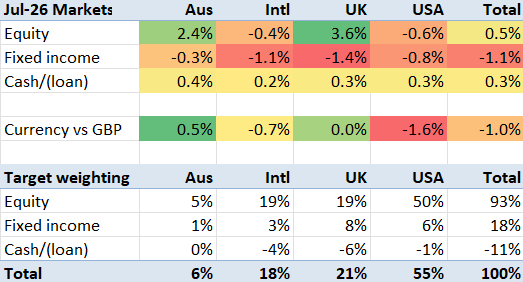
My weighted market benchmark rose marginally on a constant-currency basis, but fell by 0.8% allowing for currency movements. US and International markets generally didn’t have a great July. USD and EUR both fell slightly against the GBP. Whereas UK equities had a surprisingly robust month – with strong corporate earnings, and mutterings about a ‘safe-from-tech-nonsense’ quality being appreciated about FTSE. ASX was up over 2% too, tho I haven’t followed the reasons why.
My portfolio in July
My portfolio returned -1.3% for the month, slightly worse than my market benchmark. At this point a trend is emerging – I have lagged my market benchmark significantly over the last 12 months, whereas normally I track is pretty closely; the arithmetic total (which is a rough-and-ready measure only) of my last twelve months’ returns are +12%, vs the market’s +16%. I know one key reason for this but need to pay more attention to understand the reason for my underperformance.
I also had an unusual development occur in my portfolio – an angel investment I made many years ago went public in the USA. It has delivered a good multiple of the c.£10k I originally invested, though in fact the effective annual return (IRR) is ‘only’ 24%. There is more to say about this angel investment, and what happens when such a holding goes public, that I may cover in a future post. In any case, now that it has become a liquid investment, I am adding it to my invested portfolio – whereas before I would have ignored it, as I do all my illiquid angel investments.
This (formerly) angel investment now has a six figure value; and it has shifted a couple of my allocations a bit. It leaves me more overweight in USA equities than I would like, and very much back in my target leverage zone. I am also significantly underweight in Fixed Income, despite seeming to reinvest dividends constantly into VGOV etc.
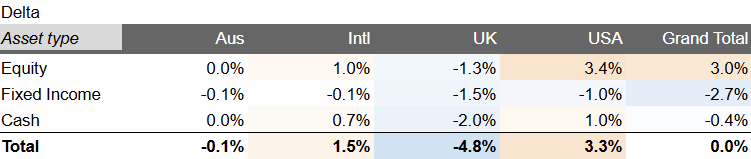
I am struggling with how to reduce my USA equity exposure. Most of it is outside my tax-sheltered accounts, and sitting at a significant taxable capital gain (the former angel investment being a case in point – this was not covered by the UK’s EIS tax breaks). I could trim my SIPP/ISA holdings, but those are underweight USA Equities anyway so I am resisting doing that. I am hoping that at some point, Something Will Come Along.
Appendix: Press clippings



The post caught me off guard because it came earlier than usual this month. Enjoy your summer and it will be interesting to learn more about what happens when a private investment goes public.
LikeLiked by 1 person
Sell in the sipp. Worrying about the diversification of individual accounts is a bias – don’t let it risk up your portfolio
LikeLiked by 1 person
as Ben notes, surely what matters is the portfolio weightings and not weights within an account. Furthermore, the account types have different tax treatment with ISA best, then GIA and then SIPP. After the tax free 25% (with £ cap) the SIPP has some capacity at lower rate tax but then 40% plus. Given a set allocation it is therefore best to have the highest return assets in the lowest tax account and the lower return assets in the SIPP account. So, likely more bonds in the SIPP (but we’ll only know with hindsight the actual rankings). This is no letting tax treatment wag the dog, but apportioning a set appetite across accounts to minimise expected tax and thus maximise after tax returns. SIPP is within estate post April 2027 as well. So , it should be positive to sell down US equity in SIPP and address the underweight fixed income.
LikeLike
Why is GIA better than SIPP? No tax advantages at all with GIA.
LikeLike
GIA, currently, has lower tax rates for cgt and slightly lower for dividends. After tax free withdrawal there may be some capacity to withdraw from SIPP at basic rate tax with potentially another c £50k a year at 40%. Currently, this leaves the remainder taxable at 45% to withdraw. If not withdrawn it is subject to iht and, if you are over 75, the marginal tax rate of the beneficiary (With potentially some tax credit for iht yet to be finalised).
so, for a larger SIPP the marginal tax rate is 45% and so any growth in the SIPP is effectively taxed at 45%.
LikeLike
Hi FvL, Awaiting a long insightful post 🙂 always enjoy reading your content. Hope all is well! Thank you in advance.
LikeLiked by 1 person
Ha! Yes sorry Kay I haven’t done too many in-depths for a while. Give me a clue – what would you value a long insightful post about? Top 3 topics….?
LikeLike
Few Ideas but please don’t constrain to these & thank you in advance!
Your Portfolio vs. a Passive 80/20: A side-by-side performance check (YTD, 3-year, 5-year) comparing your actual portfolio against a standard 80/20 benchmark to see the impact of active tilts and market timing.
Managing Liquidity for Big Purchases: How you plan cash buffers and drawdown liquidity for lumpy life expenses without taking on excessive cash drag.
Writing a Book: Whether you’ve considered packaging your UK FIRE frameworks and journey into a book.
LikeLiked by 1 person
Kay – thank you so much for the ideas!
I haven’t done the 80/20 comparison but I have done the 100/0 comparison, in particular comparing to VWRL. https://firevlondon.com/2021/01/23/reducing-my-portfolio-to-one-etf/
Regarding managing liquidity… I generally don’t proactively manage this. Check out my margin loan blog posts. There are a few of these, generally associated with house purchases. https://firevlondon.com/tag/margin-loans/
Writing a book – heavens, I find writing a blog hard enough! And I have only a few hundred followers. Not enough of a business case, I’m afraid….. but thanks for being one of those few hundred.
LikeLike