
The big news in the UK this week was the latest Budget by the Chancellor Rachel Reeves.
The scare story in the budget runup
All UK readers of this blog will know that the rumours and counter-rumours in the run-up to this budget exceeded anything we have seen before.
There were too many rumours in advance of the budget to catalogue properly here. But I want to highlight several key rumours:
- Taxes up by 2%. For a crucial couple of weeks in November, the government was rolling the pitch to break its manifesto pledge by increasing income taxes by 2%.
- National insurance on investment income, notably property rental income. This rumour felt credible to me, because it happens elsewhere – such as Ireland. However most of the commentary missed a key characteristic about NI which is that there is an Upper Earnings Limit of around £4k per month (£50k p.a., roughly) above which you only pay 2%, not 8% (or, until quite recently, 12%).
- Mansion taxes. The key rumours here were that there would be a tax of 1% on ‘mansions’ above the value of £1.5m or £2m. This move would have been the most impactful for me – with over £8m in two ‘mansions’, I was facing potential £40k p.a. of an entirely new tax.
- Pension changes – potentially reducing the ability to take around 25% tax-free, for instance.
Key measures in this budget
In the end, the budget proved to be a little bit of an anti-climax.

To quickly reprise the key personal finance measures in this budget:
- Taxes on investments (dividends, property, savings) up by 2% – but with an important caveat – see below.
- Pension contributions by salary sacrifice in excess of £2k to be charged National Insurance.
- A ‘mansion tax’ – a new type of tax – paid for by the owners of £2m+ properties. Not however paid as a percentage, but instead via an annual charge. There are four bands, from £2m upwards (£2500 p.a.) to £5m+ (£7500 p.a.). These tiers amount to around 0.1% of the property value, which for anybody with a property worth somewhat more than £2m, is much better news than “1% of the value above £2m” would have been.
- A new mileage tax on electric cars – of 3p per mile. This is a new type of tax too, despite the superficial similarity with fuel duty (which is allegedly going to increase, hooray, very gradually from next summer).
- Cash ISAs to be limited to £12k – for under 65s only.
- The 2 child cap on universal credit / tax credits is to be lifted.
The other big news was what she did NOT change. She didn’t change the headline rates of the main taxes. And she didn’t change (sorry, she “froze”), the income tax thresholds – the original Stealth Tax, because these thresholds are supposed to go up with inflation.
A lot of the commentary has been about whether or not she has broken her manifesto pledges, two in particular:
- not to change headline rates, which she clearly hasn’t broken, and
- not to increase taxes on working people, where any claim she hasn’t broken this pledge doesn’t understand inflation/ fiscal drag.
A good budget for wealthy working people
My initial reaction to the budget was grumpiness combined with relief over the mansion taxes.
I had expected something on the mansion taxes, but not the details of the proposal. I am heavily exposed here because I have not just one ‘mansion’, but two. I expect to be liable for £7500 p.a. under the new regime. This is around 0.1% of the value of my properties, every year. This has probably reduced the value of the properties by £200k. But £7500 p.a. isn’t an unduly large number in the scheme of things. If I owned modern flats in central London I could easily have services charges of that size to pay.
There are evidently around 100k properties in the UK that are worth £2m+, which is about 0.5% of all the housing stock. I remember a time when if you searched on Rightmove for properties worth more than one million pounds in Cambridgeshire there were fewer than 10 results; today there are 43 £1m+ houses for sale, only 7 of which are £2m+. I am very fortunate to own two such ‘mansions’, however un mansion-like they feel.
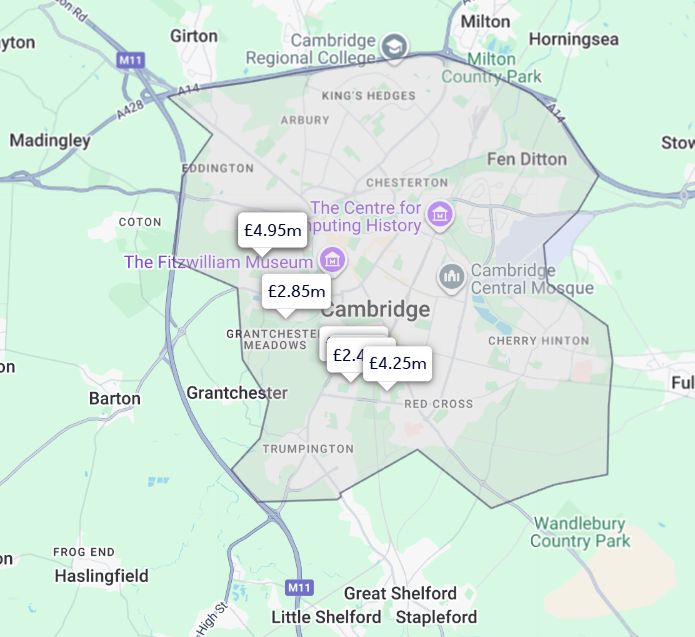
But with the dust starting to settle I realise I had missed the main impact in the budget for me – or rather the main non-impact. Which is that the additional taxes on investments only apply to the rates of investment income for basic and higher rate tax payers; the highest rate of dividend tax, of 39.35%, is unchanged.
The dividend tax rates applicable are based on your overall earnings level. So that 39.35% rate applies to anybody who is an ‘additional rate’ tax payer, i.e. has income of over £125k per year. This catches quite a lot of people – including quite a few public servants, and plenty of high earning private sector types.
Now, most high earning people do not necessarily have taxable investment income. Many of them would have all their investment/savings/capital in either tax-shelters like pensions, or in their primary home. I frequently have to remind myself that not many of us have a meaningful ‘GIA’ (a General Investment Account, i.e. a stockbroking account that is NOT an ISA or a SIPP).
But as a high income wealthy person, I have a significant amount in GIAs. And that is all taxable at 39.35%. A rate which is unchanged in the budget.
So while I am going to be affected by the frozen tax thresholds, I don’t face any tax increase on any of my income – whether earned income or investment income. (With a slight exception of the NI due on salary sacrifice pensions, though that is so complicated I don’t know what’s it worth. I think that will hit me for around 2% tax on around 8% of my pay, which is going to be a few hundred pounds at most.)
I was bracing myself for a 2% increase in taxes across the board. I felt this would have been fairer and more effective than the ‘smorgasbord’ approach the government has chosen to adopt instead.
But ironically I now find myself slightly better off than if she had hit me for 2% across the board. The mansion taxes of £7500p.a. are not as costly as 2% of my total taxable income would have been.
Dan Neidle, the tax pundit, has a piece in today’s Sunday Times (£paywall) lamenting that this is a budget that whacks the top 10% but not the top 0.1%. He’s right; for anybody with taxable income of more than £125k, there is no change in taxes, even if all that income is from investments. Whereas for ‘middle England’ (earning say between £50k and £125k in total) with taxable investment income, taxes have just gone up.
 FIRE v London
For the part of ‘middle England’ earning say between £45k and £50k in total, with prospects of modest pay rises, their tax bills will go up sharply in the coming years because of the frozen thresholds.
May I however compliment them on abolishing the bingo tax? Abolishing is good. It’s probably foolish that they didn’t abolish the salary sacrifice boondoggle while they were at it. A bicycle subsidy, for Gawd’s sake!
LikeLiked by 1 person
“… not to change headline rates, which she clearly hasn’t broken…”
Well… Income tax previously covered savings and property/rental income too – they were all just known as “income tax” before. What she has done is she has carved out savings tax and property tax out of the tax formerly known as income tax, added 2% on them to make them both 22%/42%/47%, and left just PAYE income tax where it was at 20%/40%/45%.
Add on to that the 2% increase in the basic and higher rate dividend tax, and she has effectively increased income tax across the board by 2%, with the exception of just PAYE, which she has left at 20%/40%/45% so she can hold on to the feint notion that she hasn’t raised income tax and kept their manifesto promise (correction, hasn’t raised the “rates” of income tax).
It’s all sleight of hand and leaves a very bad taste in the mouth.
LikeLiked by 1 person
I think this is reasonable though. I would expect and hope the tax rates to be different on salary compared with income from rental properties or savings. The tax system should incentivise paid employment over other forms of income. I’m not trying to bash landlords, to be clear, but I do think it’s reasonable to nudge people towards working, and a minor tax differential seems sensible
LikeLiked by 1 person
[…] was also the omnipresent UK Budget. Which has had more than enough coverage. I did a ‘damage assessment‘ at the time and haven’t revised/updated my view […]
LikeLike