
Feb ’26: Before Iran

So, for the avoidance of doubt, the end of the month is the last trading day of the month. Which for February, meant Friday February 27th.

The fact that the Israelis and the Americans invaded Iran on February 28th is going to impact March, not February.

Which is just as well because I had quite a lot of activity in February.

Simplifying the portfolio, pt3

While the weather in the UK was pretty unremittingly miserable, I found myself rearranging quite a few of the portfolio’s deckchairs.

One of my longstanding and most thoughtful readers made a comment on my blog recently that resonated with me. @Grasmi is a Brit who has emigrated abroad – to Australia, so far as I can gather. He is a bit further ahead of me on the path to portfolio enlightenment, and here is what he said:

I vastly simplified my portfolio years ago. I’m down to 8 positions now (7 ETF’s and BRK – so basically 8 ETFs). Never looked back. Less levers to pull = less stress and “busy work”.

After doing the cleanup a long time back, over time you basically “can’t” fiddle any more due to CGT… which is a lot of ways is quite freeing. There’s always a temptation to do something, but once you’ve got large accumulated CG’s in a simple portfolio, that urge goes away. Any change you make needs to make back the cost of any CGT bill (for me this is 20-30%+) just to break even, so I’m very reluctant to make any changes.

Longtime readers will know I went through a concert effort at simplification back in 2020. What I’m left with is about 90 unique holdings held across 9 brokers (6, really; 3 of them are offshore bonds/equivalent that I barely touch and don’t need to file tax reporting on). As at the end of 2025, only 64 of these holdings were in unsheltered accounts – i.e. accounts that need tax filing.

Continue reading “Feb ’26: Before Iran”
Oct ’25: Trim, trim & trim

October in the markets was one of those slightly giddy months. My portfolio crossed through a big number threshold, and kept going up.

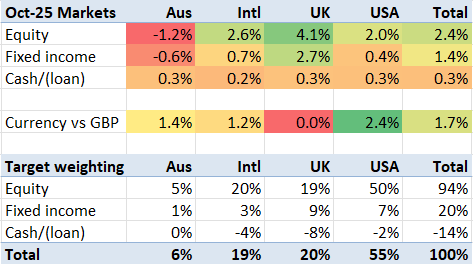
The market stats don’t quite tell the whole story. On a constant currency basis, markets rose 2.8%. Non-UK currencies (AUD, EUR, USD) rose (versus the GBP) about 1.7% too. So my weighted benchmark rose 4.6%, measured in GBP. My (leveraged) portfolio‘s rise of 5.3% is roughly in line with that.

A 5% gain in one month is pretty extraordinary, but it does happen. While October was the best month since January 2023 (+6.6%), I have had 7 better months in the last 13 years.

However, what the market stats don’t show is what it really felt like in October.

Continue reading “Oct ’25: Trim, trim & trim”

What’s the ideal level of leverage?

I’ve used portfolio leverage to help me buy two properties in the last 10 years.

To recap the most recent episode, very briefly, it goes as follows:

  1. In December 2021, I borrowed about 25% of my portfolio’s value to buy my Coastal Folly. I targeted reducing this to a 20% ‘loan-to-value’ (LTV) as soon as practicable.
  2. Only a few weeks later, Russia launched its full-scale invasion of the Ukraine. This disrupted the stock market, and energy markets. The energy market disruption led to a spike in inflation, which caused central banks to hike base rates. It also caused my LTV to go up, not down.
  3. I steadily paid off a bit of the loan, but the higher rates meant that my interest expenses went up 2.5x over the following 20 months.
  4. Since then however my portfolio has gained in value, and my loan has reduced, leaving it today at about 13% of the portfolio value. My interest costs are about 1.5x the January 2022 starting point, which is mildly annoying but very manageable.
  5. I’m left feeling firmly under control, with a relatively low level of risk. The two key risks that I need to consider are
    1. a hike in interest rates – which feels very unlikely
    2. a plummeting stock market – this feels a lot more likely, particularly in October 2025. But with my loan being only 12.5% of the portfolio value, even if the portfolio suddenly halved in value (a very rare and unlikely scenario) the loan would still amount to only 20% of the reduced portfolio value.

This leaves me wondering what the long term idealised level of leverage is for my portfolio.

Continue reading “What’s the ideal level of leverage?”