Life on the margin

This post drills in to the niche that I have found myself in – of having an uncomfortably high level of leverage margin during a bear market. None of this is worth trying at home so for you to continue reading I assume you are anticipating some schadenfreude, car crash blogging, or perhaps some material to share with your crazy crypto mates.

I have become quite a fan of margin lending. Just reviewing first of all the journey I’ve taken…

Normal mode: 10% leverage

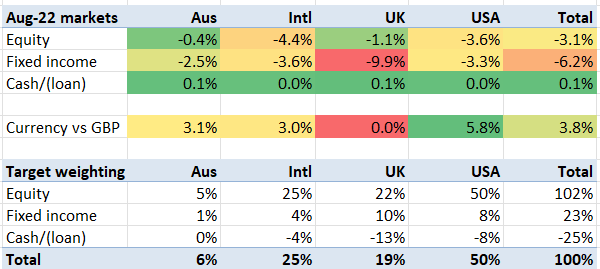
I first dabbled with margin lending, literally on the margins, about 10 years ago. More recently, about five years ago, I decided to use the lending strategically, and for several years I set my target asset allocation to include approximately a 10% level of margin – i.e. I own assets amounting to 111% of my portfolio value, having borrowed 11% to fund the purchase; the 11% loan is 10% of the total asset value. I consider this level of leverage to be minimal risk, because the dividend yield off such a portfolio will, under auto pilot, pay off about a third of the loan every year, even if the markets suffer significant falls.

Two key leverage ratios

For completeness, I should mention the rest of the debt I hold. I have a modest level of mortgage debt on investment properties, on a mixture of interest-only and repayment arrangements. These investments generate significant free cash flow, which is mostly used to (over)pay down mortgage principal. I have no other significant debts. Unless otherwise stated, I ignore the mortgages when talking about my leverage level.

In terms of affordability ratios, in normal mode my total loans (including mortgages) amount to about 4x my income (including investment income), and about 10% of my net worth (including properties). Nothing here that would give my bankers too much trouble.

Unorthodox procedure 1: buying House 1

A key moment for me was when I took a large risk in 2016 by buying my Dream Home with a margin loan. I pushed my Loan To Value temporarily up to almost 40%. To be fair the Value here wasn’t my entire household net worth, it was only my own liquid portfolio, but it was still a level of leverage that could have caused me trouble. Fortunately, for a reason of anticipated reasons (windfalls I was expecting) and unanticipated reasons (Brexit hitting the pound, which reduced the value of my loan against my global portfolio) and the extended stock market boom, I never looked back from that initial high level of leverage, and four years’ later I had my leverage back down to 10% again.

It is worth highlighting the simple arithmetic behind my leverage fall from 38% to 10% over four years. Falling from 38% to 10% is a drop of almost 75%. And indeed during that time, my loan shrank significantly, but ‘only’ by 55%. At the same time my gross assets increased in value by 51%. The combination reduced my loan as a % of total value by ~75%, to 10%. Rising markets hide naked swimmers, and they rapidly reduce leverage (which is why we should expect western governments secretly to support inflation for a few years yet).

Continue reading “Life on the margin”

June 2022 – drawdown breach!

June was gloomy.

Not in London, which is lively, crowded even – and a delight to see. Pavements are busy, restaurants are proving tricky to get bookings in, the river is heaving. I even managed to get to ‘the beach’:

Sand, tides, sunshine – locally in London

I managed to spend a bit of time down around the Coastal Folly too. I’m still finding my rhythm having two homes but so far it is going pretty well. A London kitchen project is running late / badly which gives us plenty of excuses to be down by the coast.

Sandbanks, tides, sunshine – down by the coast

The UK saw a week disrupted by rail strikes but with Working From Home now an option and so many cycle/etc options it didn’t feel too disruptive for me. It was interesting though how positively the union leader Mick Lynch came across in the media and I think if we do find ourselves in a year of employee-driven strikes he will deserve the credit/blame for it. The RMT appears to be asking for about 9% pay increases for train workers. Drivers are coming up next, apparently, along with GPs (asking for 30%!). We are rapidly getting away from ‘inflation is just spiking up temporarily’ to ‘well, if they’re getting it, then I want it’ and that could take years – and a much more competent government – to shake out.

And it is this inflation gloom which is suddenly pervasive. Not just in the UK, though the UK does appear to be taking a particular bruising. Markets got hammered in June and, lest anybody forgets, they hadn’t had a good run of things earlier in the year either.

Continue reading “June 2022 – drawdown breach!”

What’s cheap?

Ouch. As of the 16 June, my portfolio is down 9.5% so far in June. Admittedly, my portfolio is leveraged (don’t try this at home, or arguably anywhere else!). Presumably at some point, it’s time to rustle down the back of the sofas, sell off the candlesticks, or forgo a weekend out and use the cash to start buying?

How many do I have to swallow?

Swallowing knives

I have been nibbling at falling things for a few months now. That’s partly how I’ve ended up in my predicament – my leverage is higher than it’s been since the halcyon days of 2016. Everything I bought cheaply earlier in 2022 has now dropped further. For instance:

  • In January I bought my first SHOP for just over $800 (40% down on peak – me spotting a bargain). A bottom-hunting Limit Order then bought more in March, at just over $500. Then I bought more in May at closer to $300. Today, it’s at $305. My January purchase is down over 60%.
  • In February I topped up ULVR, deliberating rotating into something ‘inflation friendly’. In February ULVR traded at around £38. Today my February purchase is down about 6% at £35.61.
  • In March I topped up MMM, a long term hold, at the price I first paid for it over 6 years ago – around $145. Back then its dividend was around $4.44; now the (ever increasing) dividend is over $6. That was a third more income for your money. But since March it’s down 10% at $131. That dividend is going to keep increasing though, you watch.
  • In April I thought HL had become cheap, at under £10/share (down from a peak of £24 in 2019). In 2019 that £24 bought you a dividend of 33p – a yield of 1.4%. But the share price has dropped in the last 2 months over 20% to £7.66. Now the dividend is over 40p – that’s a 5.2% yield. That’s 3.7x more yield in 2 years.
  • In May I’m hurting some, but stretch my margin / appetite / common sense and buy AMZN for (old money) $2200. In the last month it’s dropped over 6%, with a 20:1 stock split not making an appreciable difference. I also bought ADS, thinking branded trainers feel reasonably inflation proof too, on a dip at €180. In the same month, ADS is down 10%.

The tech sector is where the pain is most acute. The car dealing companies CZOO and CVNA catch a lot of headlines, both down over 90% since January alone. Unprofitable growth businesses have typically dropped 60-80%. The FTSE doesn’t have any of these, which has helped protect it. But AMZN makes far more profit than its critics ever imagined, as does GOOG and META and of course MSFT. These are all down 30-50%.

Tell me when this stops

At what point do we hit the floor? A big problem right now is knowing where the floor is.

Continue reading “What’s cheap?”