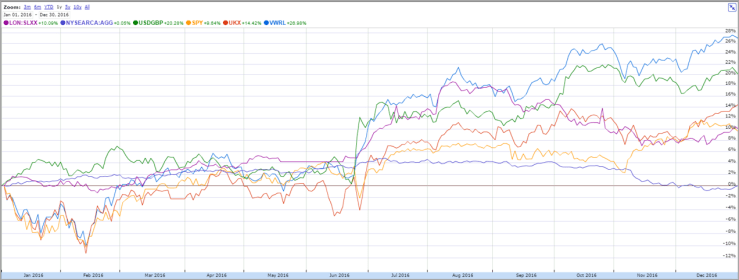
For the last few years I have been running a small High Yield Portfolio (HYP) as an experiment. The performance of this portfolio has been underwhelming, to say the least. I’ve taken some time recently to dig into the performance in more detail to examine why the performance is so lacklustre.
The theory: take steady income, and gear up
The thinking behind my HYP was clear:
- Set up a HYP in a US dollar account. Let’s call it $100k to keep numbers simple.
- Gear the portfolio up. With USD interest rates at <2%, I was targeting a general level of gearing of about 2:1. I.e. I’d have about $200k of assets, and $100k of loan costing me around $2k per year.
- Pick securities, of any type, which had the following characteristics:
- Yield of above 4%. I have averaged yields of around 6%. This amounts to $12k of income (6% of $200k).
- A historically steady share price. Or, if I have to, a slowly rising price – e.g. AT&T.
- No obvious warning signs of impending doom.
- Reinvest income. I don’t have any particular science to this – sometimes I buy on dips, sometimes I add a new holding.
- Pay a modest amount for ‘volatility insurance’. My way of doing this was to hold a short position on the SPY tracker, amounting to about $20k. This reduces my loan by $20k but costs me about 2% too so it doesn’t really change my $2k per year total cost. My average in-price for that short position is 131, which tells you how old this portfolio is (hint: SPY is now at about 224!).
- In theory this would lead to a portfolio with $100k net asset value, average income of about $10k (i.e. 10%), and a manageable level of volatility. I think I might also expect some drop in capital value, if I’ve bought assets whose yield is because they are effectively selling off assets.
- This portfolio would not be tax-efficient because the gross income of $12k would all be taxable (and investment interest isn’t deductible in the UK) but even net of tax the level of return would be about 6%. This isn’t stellar but if it was reliable year after year I would be quite pleased with it. Ideally it would also deliver a modest level of capital gain too.