My performance in Dec ’16 – Santa Rally

Phew.  The year’s over.  What an incredible twelve months. I made a big change in my portfolio in January and each month since it’s been a fascinating journey – at times nail-biting, at times frustrating and at times pinch-yourself good.

In this post I’m going to record the month’s performance before in the next post widening the view to 2016.

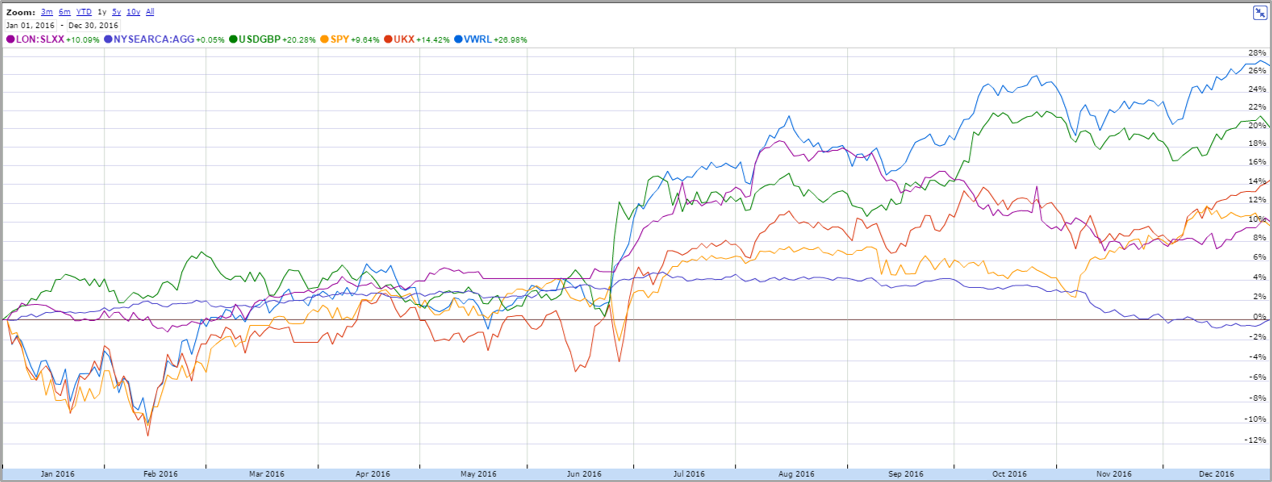
I didn’t notice any particularly market-relevant news this month.  The US market kept the gains it had delivered after the Trump election victory.  But the UK market decided to go on quite a tear, a so-called ‘Santa rally’ that continued throughout the month, with equities up 4.8% and reaching a record high – FTSE-100 closed up 5.8% at 7140.  Resource stocks rose sharply which provided a significant lift for the FTSE-100.  UK bonds rose slightly too, clawing back some of the Q3/Q4 falls.

2016-12-market-performance

Other equity markets rose too, with the European equity market up over 6% and the Australian market up 4%.  The US rise of 2% seems almost paltry by comparison.

Fixed income was essentially flat, outside the UK.

The US dollar continued its relentless rise, up 1.3% against the pound.  But the pound rose against the Ozzie.  Overall currency movements only affected my portfolio by 0.6%. By comparison the markets I’m in rose by 4.4%, weighted by my target allocation.

How did I perform compared to the averages in my markets?

Continue reading “My performance in Dec ’16 – Santa Rally”

Wellcome inspiration: a 10 point checklist

The Wellcome Trust caught the news this week. Its claims to fame this year include:

  • It is the world’s second biggest charity (behind Bill & Melinda Gates).
  • It has donated over £1bn last year.
  • Its boss, Danny Truell, is the UK’s highest earner in the charity sector. His pay rose £1m to £3m last year on the back of excellent five year investment returns.

Continued outstanding performance

I first studied the Wellcome Trust in 2012. At that point it had about £14bn under management, and about 20 investment professionals.

The Trust has just posted strong investment returns of 19pc, takings its assets up £3.5bn to £20bn. Managed by 25 people.  I’d say its boss is earning his pay.

Last year’s excellent results were largely because the Trust made an strategic decision about a year ago to downweight its sterling exposure. Apparently normally it wants at least 25pc UK exposure, but sometime pre-referendum it decided to waive that requirement. Its assessment was that the Brexit risks were asymmetric, with much greater downside than upside. This was a very similar perspective to my own call in January this year, which has served me very well too. I’d love to know how exactly they implemented the shifts involved as it isn’t easy to do without trading costs.

The fund has compounded over 15% since 1985.  This is astonishing performance, of a Buffett-beating level. Over time the Trust has consistently outperformed the market, without running extra risk.

A Wellcome Trust 10 point scorecard

My assessment of the Trust highlights 10 characteristics it follows. Many of them I share, but not all.  These ten points are as follows (apologies if you’re reading this on a smartphone!): Continue reading “Wellcome inspiration: a 10 point checklist”

Injuring private bankers’ wealth

This post is a follow-up to my September post – how private bankers injure your wealth.

I recounted how I was rather horrified/shame-faced to analyse the fees I’ve been paying one of my private banks for far too long. When you considered the double layer of fees due to my ‘fund of funds’, I was paying around 2.05% for a discretionary portfolio.   And the performance didn’t in any way justify this level of fees.

I had some very useful comments about my predicament.  The gist was that I should try to negotiate.  Perhaps I could even offer to introduce some total suckers very daft friends to the service. The commenters included people, like me, who do value the service from a private bank and who empathised with my intention to keep the relationship live – albeit at a lower cost base than before.

So, what happened next?

I confronted my bank with my analysis.  I suspect they were thinking ‘what took him so long?’ because they were ready for me.  And, no, they haven’t fired me yet – unlike the other private bank in my portfolio.

It turns out they are all too happy to stop managing discretionary portfolios manually, and they have an alternative approach.  Continue reading “Injuring private bankers’ wealth”