
Mar 2018: President Chump?

March took ages.  Heck, there was even a blue moon.  So much seemed to go wrong I am probably going to miss stuff out.

Obviously Trump started a trade war.  I’m not sure the exact impact on the markets but I think this marked a clear Sell signal for S&P500.  I often think of HSBC as a proxy for global (esp. Asian) trade, and its stock tells the story as well as any. March wasn’t particularly notable except that the miserable Q1 trend continued, with hardly any respite.
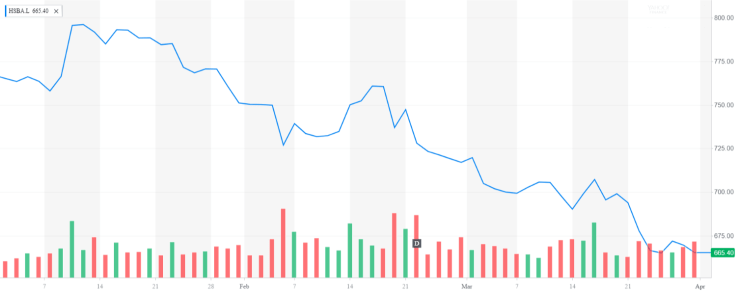
2018 04 02 HSBA.L_YahooFinanceChart

Next, and closer to home, Aviva kicked off some unwelcome news by announcing they were going to redeem their irredeemable shares.  Or something similar.  I own a bunch of similar holdings (notably NWBD and LLPC, after a helpful tip by Monevator back in 2010).  Anything which looked like a blue chip pref share with any sort of ‘irredeemable’ tag got clobbered, not entirely surprisingly.  I did a handy table mid month showing the extent of the damage inflicted, at peak. At one point I was down almost 1% of my total portfolio thanks to this mess.  Talk about unexpected correlations.

2018 03 redeemable pref shares

Fortunately, by month end Aviva had relented and these holdings had mostly regained their poise.  I think hindsight will show that we were lucky it was Aviva which played with redeemable fire here – Aviva has a strong ethical position and was successfully shouted down by small shareholders.  Had RBS/Lloyds/Santander had a crack I am not sure we’d have been so lucky.  And now it will be harder for anybody else do have a go in the future.

While we are talking about unforced errors, for some reason the global media decided March was the time to take down Facebook 50m pegs or two.  Having read Dominic Cumming’s riveting BrexitRef blog post, I somehow felt that this news horse had bolted about 18 months ago, but I must have missed something.  In any case Facebook’s market cap shed about $40bn, which is a lot of unicorns.

Continue reading “Mar 2018: President Chump?”

Feb 2018: Vix is not a vapor rub.

Well well, February was an interesting month in the markets. For once, the markets were the news.  Heck, versus Italian general elections and German coalition building, almost anything would be interesting.

Writing about one month on, and a few days into March, I can’t even remember what triggered the commotion.

But commotion there was.  Markets fell by around 10% in early Feb.  The VIX volatility index skyrocketed and then, if memory serves, stopped being tradeable.

By the end of the month there wasn’t so much to report, except flesh wounds almost everywhere you looked. The pound fell, plus ca change, and the Ozzie markets didn’t move much, but most developed world equities ended the month down by around 3% or more.

2018 02 FIREvLondon markets exposure

But actually a 3-4% drop doesn’t capture the emotions of that first week of February.  Entering February at almost 7600, the FTSE-100 index dropped by 9 February below 7100.  And the S&P-500 fell from around 2850 at the end of January to below 2550, a fall of more than 10%, on Feb 9th.  As various blogs have reminded us, such volatility is in fact the long term norm, but it felt very unusual compared to the last few years. I felt curiously Zen about the drop – as aware of my cognitive biases as I ever have been.

Back in my ranch, I finally made the jump in moving my main portfolio tracking spreadsheet over from Microsoft Excel to Google Sheets. This is not a painless process but certainly makes updating the totals a lot easier thanks to the GOOGLEFINANCE() function.  It has however slowed me down for the various month end processes I follow – hence this post is about a week late.
Continue reading “Feb 2018: Vix is not a vapor rub.”

Loans: what can possibly go wrong?

Just over a year ago, an unusual opportunity arose.  A friend asked if I might be up for lending his small property development company some money.  I ended up going ahead with it.  What happened? What lessons can I learn?  I’ll share the former, hoping my readers can help me with the latter.

Who was the borrower?

The loan was to a small private company doing real estate development. Basically they buy buildings in London where they believe they can get planning permission to increase the number of dwellings; they then maximise the planning potential of the buildings, do the work themselves, and sell on the units. They’ve got a few years’ successful track record.

I have known the three principals for over twenty years; one of them is a very close friend of mine, admittedly one who has radically different approaches to FIRE/money/investing.

What were the terms?

I reached agreement as follows: Continue reading “Loans: what can possibly go wrong?”