
My performance in Jan ’17 – Trumping begins

What a month.  First of all we get Theresa May’s Brexit 12 point plan, a.k.a. rebranding Great Britain as Global Britain (despite its lack of resonance with voters). Next we get the Trump inauguration.   Then we get Trump’s hyperactive first two weeks.  Never mind the hackneyed First 100 days of a new POTUS – Trump has done more damage to the USA’s overseas reputation less than 14 days into the job than Bush / Obama / etc managed in their first year.

Amidst all this the equity and bond markets have struggled to form a view.  USA equities are up a bit, UK bonds are down a bit, not much else to report.  Phew.

The USD has fallen a bit, thanks to concerted talking down by Trump and his putative administration.  They are accusing China of being a currency manipulator (which appears to be broadly true, albeit in the opposite direction to their claims), Germany of being an EU hegemon and currency abuser (for which there are quite good arguments, so I watch this meme with interest) and Mexico of, well, I’m not even going to go there.

For some reason the AUD has risen against the pound.  I’m not sure why. Combined with the USD fall this is quite a big shift in the terms of trade between Australia and the USA.

Continue reading “My performance in Jan ’17 – Trumping begins”
My HYP’s miserable performance

For the last few years I have been running a small High Yield Portfolio (HYP) as an experiment.  The performance of this portfolio has been underwhelming, to say the least.  I’ve taken some time recently to dig into the performance in more detail to examine why the performance is so lacklustre.

The theory: take steady income, and gear up

The thinking behind my HYP was clear:

  1. Set up a HYP in a US dollar account. Let’s call it $100k to keep numbers simple.
  2. Gear the portfolio up.  With USD interest rates at <2%, I was targeting a general level of gearing of about 2:1. I.e. I’d have about $200k of assets, and $100k of loan costing me around $2k per year.
  3. Pick securities, of any type, which had the following characteristics:
    • Yield of above 4%.  I have averaged yields of around 6%.  This amounts to $12k of income (6% of $200k).
    • A historically steady share price. Or, if I have to, a slowly rising price – e.g. AT&T.
    • No  obvious warning signs of impending doom.
  4. Reinvest income. I don’t have any particular science to this – sometimes I buy on dips, sometimes I add a new holding.
  5. Pay a modest amount for ‘volatility insurance’.  My way of doing this was to hold a short position on the SPY tracker, amounting to about $20k.   This reduces my loan by $20k but costs me about 2% too so it doesn’t really change my $2k per year total cost.  My average in-price for that short position is 131, which tells you how old this portfolio is (hint: SPY is now at about 224!).
  6. In theory this would lead to a portfolio with $100k net asset value, average income of about $10k (i.e. 10%), and a manageable level of volatility. I think I might also expect some drop in capital value, if I’ve bought assets whose yield is because they are effectively selling off assets.
  7. This portfolio would not be tax-efficient because the gross income of $12k would all be taxable (and investment interest isn’t deductible in the UK) but even net of tax the level of return would be about 6%.  This isn’t stellar but if it was reliable year after year I would be quite pleased with it.  Ideally it would also deliver a modest level of capital gain too.

The practice: average returns of half my expectation

Continue reading “My HYP’s miserable performance”

2016’s amazing performance

A year ago I was scrabbling for funds to buy a house, the market was down about 5 points in a month, and Brexit seemed like a tail risk. What a difference a year makes.

My investment portfolio finished 2016 up 24%.  A record year.  Am I a genius?  Was I lucky?  Was this normal for stock market investors?

I will wager that most investors, even the sophisticated risk-friendly readers of this blog, returned less than 20% annual gain last year. Feel free to let me know your returns in the comments below as I’d be delighted to hear there are hundreds of similar ‘achievements’ out there but somehow I doubt it (1).

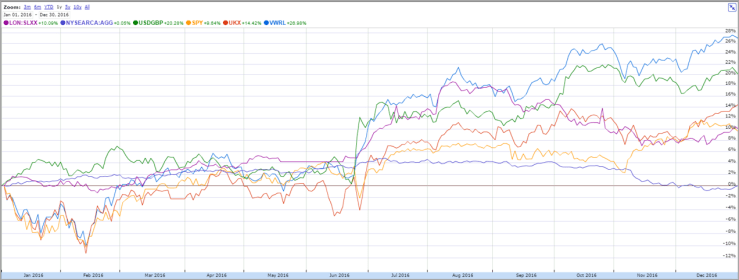
What’s been going on?  Well FTSE-100 reached a record high.  It’s the red line (‘UKX’) in my graph below.  It was in fact up about 14% on the year, plus dividends.  So a purely UK equity investor should have been well into double digits.

Bonds had an amazing year too.  Despite entering 2016 at ‘unsustainably high levels’, they carried on climbing.   At one point in August UK corporate bonds (purple, SLXX) were up 18% in the year.  They finished up about 10%.  Very few investors would be purely fixed income let alone purely corporate bonds.  But a balanced portfolio of, say, 60% equity 40% bonds would have returned about 13%.

If your portfolio returned less than 13% then you have materially underperformed.  Which is quite a statement.

Of course as my readers will know I invest much more widely than just the UK.  The UK accounts for about 6% of the world’s stock market.  The USA is about 50% of it.  How has the USA done?  Well its bonds (purple, AGG, in the graph below) have not moved in the year, unlike the UK’s (actually they did move *in* the year but they ended up where they started).

2016 returns by asset graph.png

Continue reading “2016’s amazing performance”