
Avoiding tax in the UK

I was asked to help a friend of mine, a (~50 year old) widow, complete her UK tax return recently. In the UK the final deadline for filling in your own tax return is 31 January, and the process these days can all be done online via the taxman’s excellent website. Her finances were illuminating.

What is a rich widow?

This widow’s income is roughly as follows:

  • £45k of earnings. She is a freelance creative.
  • £25k of investment income, about half of which was taxable (‘unsheltered’). She has about £700k of investments, roughly half in tax-free accounts (ISAs/SIPPs), and half unsheltered. She has no other income-generating assets.
  • £10k of contribution to her pension. She is a (non-executive) company director of her ex-husband’s company which doesn’t pay her but does make £10k per year payment into her SIPP.
  • £12k of (realised) capital gains last year, all in unsheltered accounts .

This lady’s total income/gains last tax year amounted to over £90k. This puts her in the top 10% of the UK by income, but not the top 5%.

But how much does an ‘average striver’ pay in tax?

Now, before we continue with my widow friend, let’s have a think about ‘average Joanna’, a typical striver in the UK.

Consider Joanna, a (hypothetical) 50 year old who works full-time for the NHS, earning £45k (roughly the London average wage). For a like-for-like comparison, her pension (contribution, from her employer) and (NHS pension investment equivalent) income on top of this would add about £25k to her taxable income, all tax-free.

Joanna pays £6.6k of tax, and £4.4k of national insurance, totalling £11k of tax/NI. This works out as 24% of total gross pay.

How much tax does this ‘rich widow’ making £90k pay?

“the art of taxation consists in so plucking the bird as to obtain the largest possible amount of feathers with the smallest possible amount of hissing.” – Colbert, paraphrased

What total tax/social charges (National Insurance, in the UK) do you think she owes on her annual income/gains?

Before continuing reading, think of a number.

Continue reading “Avoiding tax in the UK”
Leverage reaches its limits

Longstanding readers will know that I have been an avid user of leverage, ever since I used it to buy my Dream Home in January 2016. At that point I was able to borrow funds, very flexibly, secured on my portfolio. And rates were well under 2% in all major currencies.

When I started my leverage journey, I was borrowing over GBP1m, in a ratio of 3:2 GBP:USD.  The rates on both were, from memory, between 1% and 1.5%. At this point the interest is more than covered by the after-tax dividend income on the securities, leaving any capital gains or untaxed income as leveraged upside. My main concern from having debt was not the financing cost, but the leveraged exposure it left me with – a 10% drop in markets would have hit my portfolio’s value by around 15%, and potentially left me vulnerable to the bank calling in some of the debt (via ‘margin calls’).

Since January 2016, base rates have started to climb – for the first time since the Global Financial Crisis in 2008. This change was long heralded and a long time coming.

I’ve been aware of the change in rates posture, but not been paying too much attention.  After all UK base rates have risen to only 0.75%.  Euro rates haven’t changed.  But I must admit I had somewhat missed the fact that US base rates have risen above 2%.  Two per cent!  That’s becoming a proper base rate.

In the meantime, I’ve succeeded in reducing my leverage very significantly.  In debt terms, by around half.  In loan-to-value terms, by more than that – because my portfolio has grown as my debt has shrunk.

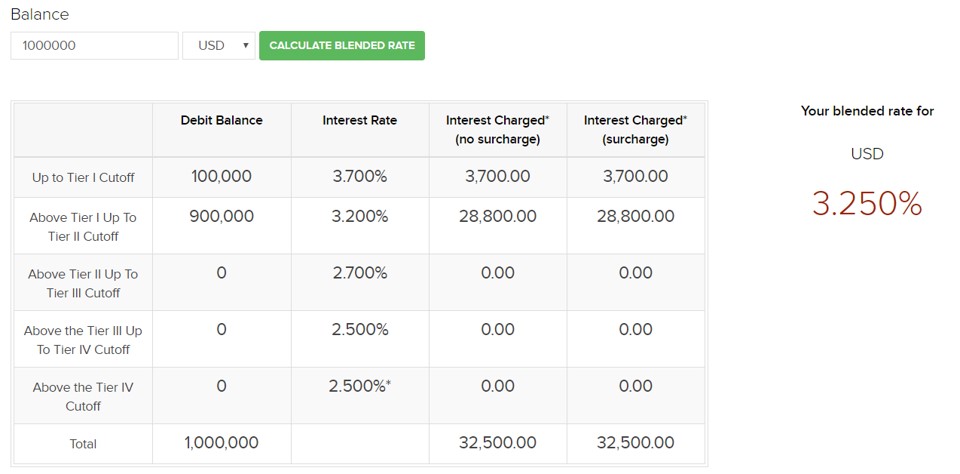
I recently reviewed the rates I’m paying for my margin loan and finally clocked that now my USD debt is costing me over 3.25%.  IB’s rates start at 3.7% and then drop to 3.2% up to $1m of loan.  This much higher interest rate has made me reconsider my target leverage.

2018 11 20 USD IB rates

With USD rates over 3%, but my loan to value being around 15%, my main concern now is the financing cost / spread, not the level of exposure/risk.  Paying interest of over 3.25% out of after-tax income now requires yields of 6% or more, which is getting into ‘high yield’ securities only – something that I know from experience tend to deliver pretty poor total returns. Of course capital gains may yet deliver an overall gain, even after tax and interest costs, but that is much more of a gamble than I faced two years ago, especially with October’s correction still a very recent memory.

Continue reading “Leverage reaches its limits”

Overdiversity

Diversification is the “only free lunch in investing”, and I love it. However, I came to the conclusion as I started tracking my investment performance rigorously that I had overdone it. Since that realisation I have been rowing back slightly. I appraised my progress recently, and this rather dry blog post sets out my findings.

I track all my investment portfolio holdings in one single investment spreadsheet. One advantage of this approach is that I have a consolidated view of my portfolio which ‘de-dupes’, and makes it fairly easy to see large positions that amass when I buy the same ETF in multiple portfolios.

What is the appropriate number of holdings to diversity accurately? You’ll find as many answers as responders to that question. But consensus seems to suggest 20 holdings is more than sufficient, especially if you are using collective securities such as index funds or ETFs.

When I began my unified tracking I had no fewer than, erm, 228 holdings. Over two hundred holdings.

Almost every single one of my holdings I have personally chosen. With a reasonable amount of consideration, time and of course fees associated. Multiply this by 228 and pretty soon it sounds like a lot of time wasted.

How did I end up with 228 holdings?

Here is the breakdown from late 2013:

  • 29 ETFs. Of these 29 (15%) of them were ETFs, amounting to just over 30% of the total portfolio value. VUKE was originally my largest, at just under 10% of my total portfolio; these days IUSA is my biggest, with about 5% of my portfolio.
  • 57 Funds. Ouch. This was a testament to having used my fair share of IFAs and private bankers over the years. This lot added up to around 25% of my portfolio’s value. The largest holding was about 2% of the total.
  • 122 equities. Half my holdings are directly held equities. They amount to about a third of my total portfolio value. They included, originally, 57 holdings of less than £10k each.
  • 12 bonds. Individually held bonds are quite exotic things really so no wonder I don’t have many. Though my largest is 2% of my portfolio, the total amounts to only 5%.
  • 8 cash equivalents. Eight! Five separate currencies, held in 8 different ways in total.

I decided, roughly when I wrote my Investment Philosophy, that this portfolio was needlessly complex and should be slowly pruned. The complexity cost of such a large portfolio is significant:

  • Higher transaction fees. My minimum opening position used to be around £1000. At this level I am doing a lot of transactions and my in/out fee is over 2% even before stamp duty. With a higher average trading amount I cut my fees.
  • Higher paperwork/admin time. Almost every single one of my holdings spits out income payments. I track many of these individually. Typing in £0.31 of tax credit on a Fidelity account for some <£2000 holding is not good use of time.
  • Reduced mindshare. Warren Buffett has long espoused the ‘20 punch card‘ approach. He has a point. His point is choose wisely, and get it right – and limiting yourself to fewer bigger decisions improves your odds. And of course to stay up to date with 20 investments is far easier than keeping tabs on 228 investments.
  • Carrying deadweights. Looking back at my 5 year old portfolio I recognise holdings that I knew were suspect, but I ducked the challenge of making a decision to liquidate them. When they’re small, the damage they are doing to the portfolio doesn’t feel worth the bother.
  • Diluting my best picks. Some of my best performing investments have been my smallest. I have had a hunch, and invested £2k, £5k, or something similar. If I’d made my entry ticket bigger, and adopted a different approach to selling out duds, I think I’d have made more money without taking on appreciably more risk.

In any case, after quite a lot of gradual pruning, optimising and spring cleaning, my current portfolio looks considerably better on my ‘overdiversity’ measures:

Continue reading “Overdiversity”