Ouch-tober 2018

I have to take my hat off to Theresa May for her performance in October.  Dancing (well, jiving, at least).  On stage.  To kick off her make-or-break appearance at the Tory conference.  That lady has balls.

The big news this month has been foreign.  Alien, even, in the case of another lady with balls – Jodie Whittaker (“Why are you calling me Madam?”) breaking the Doctor’s glass ceiling.

201b083131874d9b1476d9d7029f0302

We’ve had Saudi Arabia in the news for much of the month, for some gruesome reasons. We’ve had foreign governments getting a whipping in Germany or, Royal visit notwithstanding, losing their majority in Oz.  We’ve had the USA administration pulling out of a Russian nuclear arms treaty.

And of course, we’ve had the major geopolitical upheaval that is a new phone from the most important FAANG.

I suppose a quick recap of the worldwide developments would, on balance, suggest downward pressure on the markets.

I really don’t think however that Doctor Who, returning to Earth after a prolonged absence and reviewing  recent developments, would expect such a brutal, consistent month in the equity markets.  Everywhere.

October saw the biggest market drops since my monthly portfolio tracking began in January 2013.  In fact The Economist says October saw one of the top 10 biggest monthly falls in the S&P 500 since the 08/09 crisis.
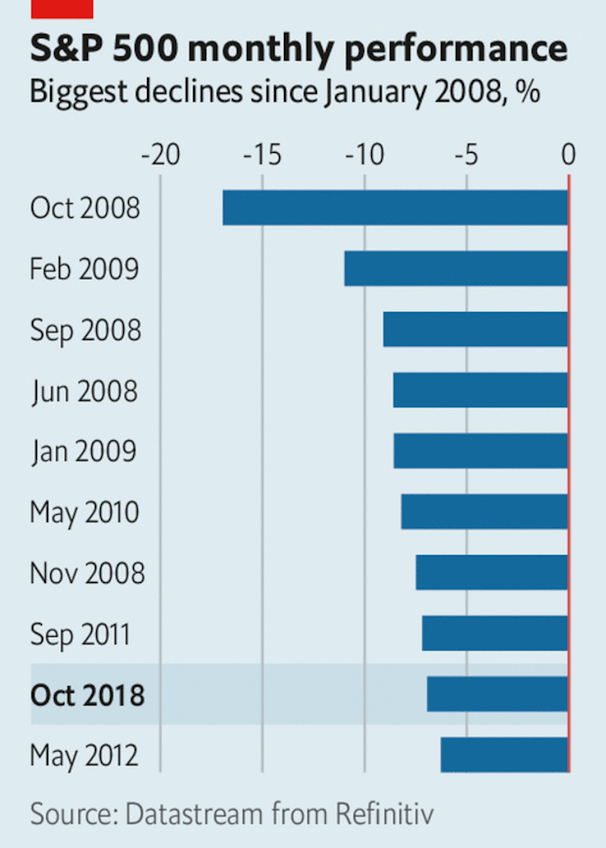
2018 10 biggest monthly falls Economist
S&P 500 monthly performance; biggest declines since Jan 2008

The Sunday Times shows the worst months for FTSE since the 1960; October 18 isn’t one of the worst 10 but most of the worst ones were more than 30 years ago!

Worst months for UK stock market since 1966 (Source: Sunday Times)

What was clear, as October drew on, was that everything seemed to be falling.  Asian markets have had a tough year already, largely due to Trump trade spats.  European equities have similarly faced trade headwinds.  But now the USA, Oz etc fell sharply too. The Sunday Times has a nice graph in fact:

How FTSE compared with other global stockmarket indices in October 2018 (Source: Sunday Times)


Most noticeable for some of us was the big drop in tech stocks.  Some FAANGs had fallen 20% at points; only AAPL seemed relatively immune from the sharp change in sentiment.

2018 10 FAANG stocks

Amidst the hysteria, you’d have been hard pushed to notice that bonds were relatively unaffected by this carnage.  UK corporate bonds actually went up almost half a percent.  For once, correlations didn’t all converge.

2018 11 02 Tweet wow bonds

Currency movements deserve a brief mention too.  For UK investors October was another month of big Brexit-driven swings.  The pound rose against the USD above £1:$1.32 at one point, before falling to £1:$1.27 where it pretty much finished the month.  The dollar won the October currency battle, which took the edge off the S&P being the biggest casualty in the equity contest.

2018 10 FIRE v London market returns weights

Continue reading “Ouch-tober 2018”

September 2018: whiplash

The major UK news in September was the Salzburg EU summit, which saw the UK PM become a victim of political whiplash.  This affected the markets, but not entirely predictably.  If you’ve been asleep in September, you’ll struggle to see the ‘surprise’ summit result in the financial charts.

The Trump saga was preoccupied with the Supreme Court last month.  This doesn’t obviously translate into market sentiment, thank goodness.

Image result for whiplash cartoon

Nonetheless, from a UK markets point of view, September had its own form of whiplash.

Taking just the UK, for instance, consider equities (FTSE-100) and sterling. FTSE-100 veered between 7550 and 7250, a swing of 4%. By contrast, the S&P-500 nudged between 289 and 295 – about half as much change in the month. Meanwhile, GBP:USD veered between 1.282 and 1.328, a swing of almost 4% as well.

The FTSE-100 and GBP:USD are correlated, of course.  The USD is the ‘currency of the world’, and FTSE-100 companies mostly are global businesses, trading heavily in USD.  So when the GBP falls, the FTSE-100 goes up – these are the same companies, and valuing them in USD makes in many ways more sense than valuing them in pounds.

But the total swing of the FTSE, measured in dollars, was over 5% in the month.  And back again.  This means any particular snapshot of returns feels very arbitrary indeed. Those of you who ignore month to month movements are definitely on the high ground here.

Anyway, be that as it may, as at the end of September FTSE was up just over 1%.  Sterling itself rose too, about half as much.  And, so it happens, so did the S&P.

2018 09 FIRE v London markets

Bonds, on the other hand, are heading down.  With rate rises firmly on the agenda, the economy ‘booming’ (ish), now isn’t a very bonds-friendly time.  Or at least that is my superficial read on the situation.

Continue reading “September 2018: whiplash”

August 2018: US 1, UK 0

I’m not really sure what happened in August.

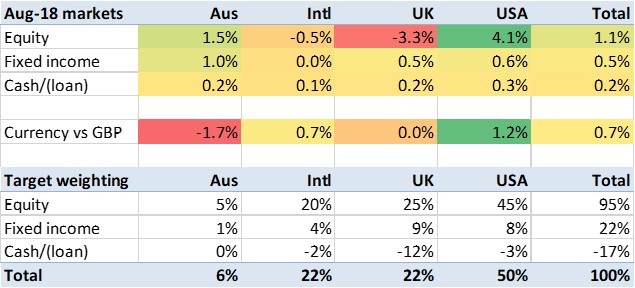
At least, you’d think something quite significant happened, given that UK equity markets fell over 3% and US markets rose over 4%.

The swing of the US:UK currency itself was notable during the month but over the month fairly minor – with the USD gaining slightly based on 1 August (but the gain having been much bigger only a week ago).

The Australians have joined the Brits, Americans, French, Italians and Swedes in bewilderment at the nonsense their politicians can get up to.  But the Australian markets haven’t moved much; the currency fell and the equities rose in compensation.

The USA appears to be making more ‘progress’ on trade, with the news at the end of the month being about some Mexico/NAFTA-related agreement.  Maybe that helped.  Maybe.

In the UK we saw the media running with the ‘no deal’ ball.  How much of this was silly season, and how much reflected the overlooked aspect of the Cabinet’s Chequers deal in which they agreed to take ‘no deal’ planning much more seriously, I couldn’t say. It has certainly nudged me to move my portfolio a bit more out of the UK than I might have done.

So, all in all whatever drove the big market movements in August somewhat passed me by. But 6 point swings between UK and US equity markets, after currency effects, are not common.  Thank goodness I have almost double the allocation to the USA – which rose by over 4% – than to the UK – which fell by almost as much.

2018 08 FIREvLondon weighted markets

Continue reading “August 2018: US 1, UK 0”