The stocks & shares ‘property’ portfolio, one year on

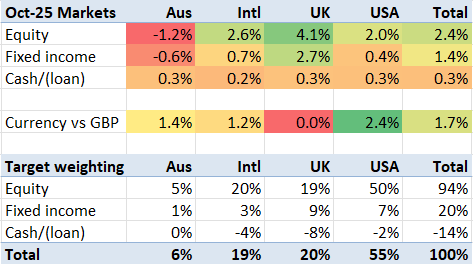
A year ago this week I sold my Modern Flat. And shortly afterwards, I reinvested £500k into a liquid stocks/shares portfolio with a property-like mandate. One year on, here’s a short review of the performance.

The portfolio has been set up to spit out £2000 pcm, which I take into general household expenses. This amounts to a 4.8% withdrawal yield on the £500k initial portfolio value.

What’s happened?

I ran out of money once, by about £100. As it happened, when that happened I ended up receiving a dividend on the 31st of the month which meant I had *not* in fact ran out of money, but by then I had already lent the portfolio the money to cover. I charged the portfolio £50 of interest costs for the trouble.

Continue reading “The stocks & shares ‘property’ portfolio, one year on”

What’s the ideal level of leverage?

I’ve used portfolio leverage to help me buy two properties in the last 10 years.

To recap the most recent episode, very briefly, it goes as follows:

  1. In December 2021, I borrowed about 25% of my portfolio’s value to buy my Coastal Folly. I targeted reducing this to a 20% ‘loan-to-value’ (LTV) as soon as practicable.
  2. Only a few weeks later, Russia launched its full-scale invasion of the Ukraine. This disrupted the stock market, and energy markets. The energy market disruption led to a spike in inflation, which caused central banks to hike base rates. It also caused my LTV to go up, not down.
  3. I steadily paid off a bit of the loan, but the higher rates meant that my interest expenses went up 2.5x over the following 20 months.
  4. Since then however my portfolio has gained in value, and my loan has reduced, leaving it today at about 13% of the portfolio value. My interest costs are about 1.5x the January 2022 starting point, which is mildly annoying but very manageable.
  5. I’m left feeling firmly under control, with a relatively low level of risk. The two key risks that I need to consider are
    1. a hike in interest rates – which feels very unlikely
    2. a plummeting stock market – this feels a lot more likely, particularly in October 2025. But with my loan being only 12.5% of the portfolio value, even if the portfolio suddenly halved in value (a very rare and unlikely scenario) the loan would still amount to only 20% of the reduced portfolio value.

This leaves me wondering what the long term idealised level of leverage is for my portfolio.

Continue reading “What’s the ideal level of leverage?”

Swapping a rental property for a share portfolio

Having sold my London rental flat, what was I to do next?

I’ve paid the £20k+ transaction fees. I have paid off the mortgage. I set aside the amount to pay my Capital Gains Tax, a liability which needs to be settled within 60 days. I moved some of the remaining equity into other investments and portfolios.

However, one thing is missing. The property rental income. I used to use my property rental income to help pay for household costs; rent was received into my joint household account and was swallowed up there by miscellaneous household bills, cleaning costs, gardening expenses etc. Until I sold the flat, the flat’s service charge and occasional running costs would have come out of that account too. These days, only my Dream Home in London is paid for out of this account – I have opened a different account for the Coastal Folly which I run separately (and is funded separately).

So, I decided to ringfence £500k of the equity that I released for a ‘property proxy’ portfolio. This portfolio will be a worked example of the argument that a stocks/bonds portfolio can be a valid, and better, alternative to a property investment. I will report on progress occasionally on this blog. The portfolio will essentially be an income portfolio, designed for somebody is used to having regular property rental income coming in, and wanting inflation protection.

Continue reading “Swapping a rental property for a share portfolio”