Feb 2018: Vix is not a vapor rub.

Well well, February was an interesting month in the markets. For once, the markets were the news.  Heck, versus Italian general elections and German coalition building, almost anything would be interesting.

Writing about one month on, and a few days into March, I can’t even remember what triggered the commotion.

But commotion there was.  Markets fell by around 10% in early Feb.  The VIX volatility index skyrocketed and then, if memory serves, stopped being tradeable.

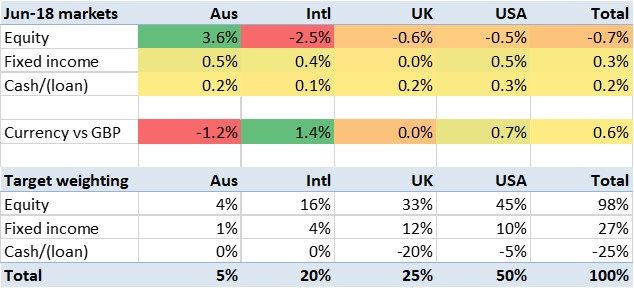
By the end of the month there wasn’t so much to report, except flesh wounds almost everywhere you looked. The pound fell, plus ca change, and the Ozzie markets didn’t move much, but most developed world equities ended the month down by around 3% or more.

2018 02 FIREvLondon markets exposure

But actually a 3-4% drop doesn’t capture the emotions of that first week of February.  Entering February at almost 7600, the FTSE-100 index dropped by 9 February below 7100.  And the S&P-500 fell from around 2850 at the end of January to below 2550, a fall of more than 10%, on Feb 9th.  As various blogs have reminded us, such volatility is in fact the long term norm, but it felt very unusual compared to the last few years. I felt curiously Zen about the drop – as aware of my cognitive biases as I ever have been.

Back in my ranch, I finally made the jump in moving my main portfolio tracking spreadsheet over from Microsoft Excel to Google Sheets. This is not a painless process but certainly makes updating the totals a lot easier thanks to the GOOGLEFINANCE() function.  It has however slowed me down for the various month end processes I follow – hence this post is about a week late.
Continue reading “Feb 2018: Vix is not a vapor rub.”

2018’s goals and January 2018’s returns

So, my normal blogging rhythm has been slowing down a bit.  Time for a quick catch-up.

January’s come and gone, and I haven’t even written up my investing goals for the year.

First of all, what’s been going on in January?

The Trump tax cuts may have technically been passed in December but it feels as if markets in January have been dominated by them.  I confess to being surprised, and pleased, to see a variety of US businesses committing to pass through some of the tax cuts to their employees – e.g. Walmart, Boeing, JP Morgan, AT&T, Disney, Home Depot and others.  This all looks quite positive for US stocks, the US economy, and probably thus world trade.

It is thus not too surprising that world equities are up, and the US dollar has fallen over 5% vs the pound.  Surely a good month to be in the UK?  Alas not, as FTSE has fallen over 2% while S&P is up over 5%.  Brits have been better holding S&P than FTSE, not for the first time.

2018 01 FvL markets

Continue reading “2018’s goals and January 2018’s returns”

2017 Q4 review: top trumps?

It’s the end of the final quarter. More importantly for me, it’s also the end of the fifth year of my portfolio tracking. In the world of asset management, once your track record has five years you are getting on the map.  So how are we looking?

How was December?

Well, starting with December, what happened?  Equities had a good month – particularly the UK where FTSE-100 rallied in the closing days with a fine Santa Rally.  There wasn’t much to report on forex or bonds.  In constant currencies, the markets I’m in rose by 2.85%; currencies then added a 0.2% tailwind, so the blended market average for my portfolio was a gain of 3.0%.  A good month to be in the markets.

2017 12 FvL Market returns

Against a market gain of 3%, December looks actually quite disappointing for me.  My portfolio rose ‘only’ 1.7%.  Why the lag?  I’m not sure; it may be a clerical error because it was all in one of my accounts, but I haven’t had a chance to drill into it. I’m still not complaining about a monthly gain of 1.7%.

How was the full year?

Looking at the wider market during 2017, it has been a very good year for investors.

Continue reading “2017 Q4 review: top trumps?”